
Fencing for a school, daycare, or playground has three jobs at once: keep children in, control who comes in, and keep clear sightlines for the adults supervising. In the Tulsa area, that usually means black vinyl-coated chain link or ornamental steel, with gates and hardware chosen as carefully as the fence itself.
We have fenced schools, campuses, and play areas across Tulsa and northeast Oklahoma, including work for Tulsa Public Schools. This guide is for the directors, facility managers, and boards planning a school fence, daycare fence, or playground project: what to build, what to ask, and what to settle before the first post goes in.

Start With the Three Jobs
Every decision on a child-facing site traces back to three goals. When two of them pull in different directions, knowing which one leads settles the choice.
- Containment: no gaps, no climbable footholds, and no way out except through a gate staff controls.
- Controlled access: visitors come in through a known entrance, not across the play yard.
- Supervision: staff can see the whole area, and so can passing patrols and parents.
That third job is why solid privacy fencing is rarely the first choice around play areas. Open fencing lets adults see in and children be seen.

The Best Fence Materials for Child-Focused Sites
Most school and daycare projects use one of the materials below, and many use two: a durable perimeter and a more finished fence where the public sees it.
| Material | Visibility | Climb Resistance | Upkeep | Common Use |
|---|---|---|---|---|
| Black vinyl-coated chain link | High | Moderate | Low | Play yards, perimeters, athletic areas |
| Galvanized chain link | High | Moderate | Low | Back-of-site perimeters and budget runs |
| Ornamental steel (Ameristar) | High | High | Low | Street frontage, entrances, front play areas |
| Chain link with privacy slats | Partial | Moderate | Low | Screening along busy roads or neighbors |
| Wood or vinyl privacy | None | Moderate | Low to moderate | Dumpster, utility, and neighbor screening |
Black Vinyl-Coated Chain Link
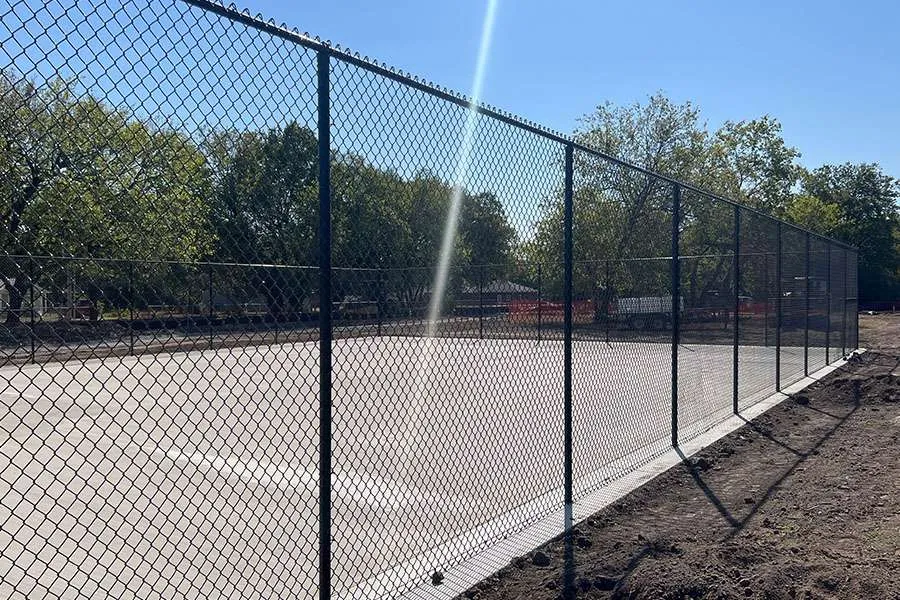
This is the workhorse of school and daycare fencing. The black coating is easier on small hands than bare wire, it blends into the landscape, and the open weave keeps full visibility. We build it on galvanized framework set in concrete, and it holds up to years of balls, bikes, and leaning. Our chain link fence page covers the options.

Ornamental Steel
Where the fence faces the street or frames the main entrance, Ameristar ornamental steel gives a finished, welcoming look with serious strength. Vertical pickets offer few footholds, and a flush top is the right choice around children. The standard picket spacing leaves about a 4-inch airspace, and a tighter-spaced aluminum style is available where smaller gaps are wanted.

Screening Where You Need It
Privacy slats in chain link, or a wood or vinyl privacy section, make sense in specific spots: along a busy road, next to a neighbor’s yard, or around dumpsters and utility equipment. Keep screening away from the main play area so supervision stays easy.
Height, Gaps, and Climbability
Three details decide whether a fence contains children or just decorates the yard.
- Height: play area fences are commonly 4 to 6 feet, and perimeter and athletic fencing often runs taller. The right height depends on the ages served, the site, and any requirements that apply to your program.
- Gaps: check the space under the bottom rail and between the fence and buildings, posts, and gates. Small children find every opening.
- Footholds: put framework rails and bracing on the inside where possible, keep climbable objects such as benches and trash cans away from the fence line, and avoid designs with horizontal members on the outside face.
Our answer on the best fence for kids’ safety covers the same principles for homes, and most of them apply directly to play yards.
Licensing, District Standards, and City Rules
Child-facing sites answer to more than one set of rules, and they do not always agree.
- Child care licensing: licensed child care programs in Oklahoma follow Oklahoma Human Services licensing requirements, which address outdoor play areas. Your licensing specialist is the authority on what your program needs, so confirm before the design is final.
- District and organization standards: school districts, churches, and larger organizations often have their own specifications for fence type, height, color, and gate hardware.
- City permits and zoning: fence permits and height limits vary by city and zoning district. Our guide to fence permits in the Tulsa metro covers who to call.
- Playground surfacing and equipment: those follow their own safety guidelines. Plan the fence line so it leaves the use zones around equipment clear.
Requirements vary, so bring your licensing notes, district specs, or insurer’s requirements to the estimate, and we will design to them.

Gates Are Where Security Lives
A strong fence with a weak gate plan is not a secure fence. On school and daycare projects, the gate schedule deserves as much attention as the fence line.
- Pedestrian gates: place them where staff can see them, and size them for strollers, wheelchairs, and deliveries.
- Self-closing and self-latching hardware: added where needed so a gate does not get left open during a busy pickup.
- Latch height: mount latches out of reach of young children, with staff-friendly operation from the inside.
- Locking: keyed or keyless mechanical lever locks for gates that should stay closed to the public.
- Maintenance and emergency access: double gates wide enough for mowers, service vehicles, and emergency access, kept secured when not in use.
For campus vehicle entrances, commercial gate operators and access control can manage who drives in and when. Our complete guide to fence gates covers sizing and gate types.

Schools, Daycares, and Playgrounds Have Different Priorities
The same principles apply everywhere, but the emphasis shifts by site.
Daycares and Preschools
Youngest children, smallest gaps, and the most frequent gate traffic. Priorities are tight containment, child-proof latches, and a clear view of the whole play yard from the building. See our daycare fence projects.
K-12 Schools and Campuses
Bigger sites with more entrances. Priorities are channeling visitors to the main office, separating parking and drop-off from play areas, and durable fencing for athletic fields. See our school fence and campus fence projects.
Playgrounds and Parks
Public playgrounds balance containment with easy access for families. Priorities are separating play areas from streets and parking, keeping sightlines open for parents, and choosing materials that hold up to heavy public use. See our playground fence projects.
Planning the Project Around Your Calendar
Fencing an occupied site takes more coordination than fencing an empty lot. The easiest projects are scheduled around the program, not the other way around.
- Time it for breaks. Summer, winter break, and spring break are the natural windows for schools. Daycares that run year-round often phase the work by play area.
- Book early. Spring and summer book up fastest, so schools that want a summer install do best starting the conversation in the spring.
- Phase large sites. Replacing a perimeter one section at a time keeps part of the site secure and usable throughout.
- Share the site rules. Tell us about check-in procedures, restricted areas, and hours when crews should not be on site.
We contact Okie811 to mark public utilities before digging. Private lines such as irrigation, lighting, and data runs are the owner’s responsibility to identify and mark, and large campuses often have plenty of them.

What Drives the Cost
Institutional fencing is priced on the same fundamentals as any commercial fence: footage, height, material, framework weight, and the number and type of gates. Tear-out of old fencing, rock, and access around buildings and equipment add to it.
Gates are often the biggest variable on school and daycare projects, because the hardware that makes a gate secure costs more than the gate itself. Our commercial fencing buyer’s guide walks through budgeting, bids, and specifications in detail.
Quality and Warranty
Every commercial fence installation is managed against Empire Fence’s rigorous quality standards. New installations are backed by our 1-year workmanship warranty, combined with robust manufacturer warranties, subject to written warranty terms.
Fencing Schools, Daycares, and Playgrounds: The Bottom Line
Design for containment, controlled access, and supervision, in that order. Lead with black vinyl-coated chain link or ornamental steel, put as much thought into the gates as the fence, and confirm licensing, district, and city requirements before the design is final. Then schedule the build around your calendar, not the busiest week of the year.
We work with schools, churches, daycares, and parks across Broken Arrow, Sapulpa, Claremore, and Catoosa, and we are glad to walk your site with your team.
Planning a School or Daycare Fence?
Empire Fence has served Tulsa and northeast Oklahoma since 1955, from backyards to campuses. Bring your requirements and your calendar, and we will build a plan around both.
- Request a free site estimate and walk the property with our team.
- Get an instant quote for a play area or smaller run in about 60 seconds.
You can also reach us directly at (918) 437-1671.
Empire Fence installs commercial and institutional fencing across Tulsa and northeast Oklahoma. See our commercial fencing services for the full range of what we build.
